Saturday, January 17, 2015
2014 Breaks Heat Record, Challenging Global Warming Skeptics
In case there was any doubt at all that our planet has been set on a perilous path due to our excessive CO2 emissions, this latest report showing that the planet's climate was the hottest on record last year, should convince even rabid global warming deniers (But of course it won't).
Thursday, October 9, 2014
Where Have All The Animals Gone?
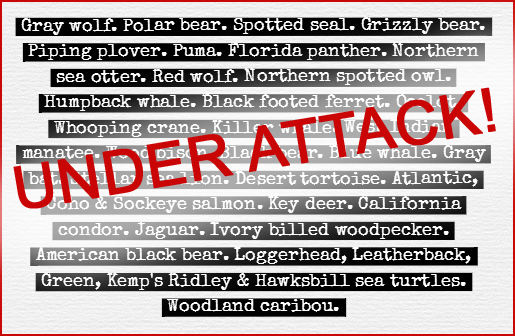
According to a new report from the World Wildlife Fund 40 percent of the world's wildlife species, and 70 percent of river species, have disappeared from the face of the earth since 1970.
Human beings have truly have become the planet's most dangerous specious--a threat to virtually ever other species on the planet. The problem is that, even if you don't care about wildlife diversity, the disappearance of such large numbers of the planet's animal populations should be wakeup call. Our planet is on life-support and getting sicker by the year. Will the end result be a mass extinction the likes of which the human race has never before experienced? One seeks to be hopeful, but our lack of collection action in protecting endangered wildlife doesn't bode very well for the future...of animal or ourselves.
Wednesday, September 17, 2014
On the Utility of Animals
Ecologist Richard Conniff has written an interesting opinion piece addressing the question of whether animals are only important because of their utility to human beings:
As a teacher of ethics, I know full well the temptations involved in appealing to utility to make the case for wildlife preservation. But making the value of wildlife contingent on human needs, I believe is a self-defeating proposition. As Conniff observes, once you start resorting to the issue of utility, you end up getting into debates about what is more important to human beings, and economic development will trump wildlife preservation just about every time.
As far as I'm concerned, the best arguments for the protection of non-human species are aesthetic and moral. Our interactions with animals in the wild--whether we are talking about the bald eagle flying overhead or the rattle snake slithering across our path--is that an appreciation for the majesty of nature in all its forms makes the human soul more beautiful and harmonious. This may sound like an antiquated kind of argument--one that an ancient or Medieval thinker might make--but I think that the argument still holds today.
The philosopher St. Bonaventure once said of St. Francis of Assisi, "In beautiful things, he saw Beauty itself." When one can come to see the divine reality played out in the lives of creatures in the wild, then one will come to see the divine reality in all living things. To the extent that these creatures are viewed simply as means to our own petty human ends, to that extent have we robbed nature of its inherent divinity. And that makes it much easier for us to ignore the threats that are facing animal species around the planet.
Thursday, August 28, 2014
Why Own If You Don't Have To?
The Millennial Generation has its collective issues--overuse of technology, self-absorption, and poor human interaction skills--but the members of this generation have virtues that we can all learn from as well. One of the unintended consequences of coming of age in a time of economic insecurity is that many of Millennials are forgoing the dubious pleasure of owning in favor of renting.
Home and car ownership among this group is noticeably down. But younger Americans are not stopping there: new economies around the United States are springing up to take advantage of young American's new-found desires to rent music, tools, household, and even clothes.
Needless to say this trend doesn't sit well with corporate America which would have us all buy new things all the time--especially things that we don't actually need or even want. But the new rental economy might be just the thing that the planet needs after decades of excessive consumption and the environmental degradations associated with our manic need to own just about everything.
So while I'm still not quite sold on all the behavior traits of the Millennial Generation--put down that damned cell phone for just a second, will you!--in this particular area, perhaps the Millennials might actually be setting a trend that all of us would do well to follow.
Monday, February 3, 2014
Blog Temporarily Suspended
Due to work that we are currently doing on other sites, posting on EcoBlog will be temporarily suspended until Fall 2014.
If you are looking for stimulating things to read, why not try one of the following sites instead:
- Wisdom's Haven - our philosophy and ethics blog, focused on some of the most important questions that human beings face in life.
- The Sophia Project - one of the largest repositories for free resources in the field of philosophy and ethics on the web.
Monday, January 6, 2014
Sustainable Happiness
It's seems to be a self-evident truth that all human beings want to be happy in life. But it also seems to be the case that we Americans have some seriously screwy ideas about happiness that may in fact get in the way of our own long-term happiness. In particular, we seem to think that real happiness is measured almost exclusively by our present economic conditions (stuff + now = happiness). Happiness is typically linked to GDP (Gross Domestic Product), a measure of how much we are producing and consuming at a given time. The presumption is that the higher the GDP, the happier the people of a nation must be. Americans have one of the highest GDPs in the world, so naturally, we must be among the happiest people in the world, right?
But what if the very lifestyle that we are living in the present is a threat to our long-term sustainable happiness and well-being? Imagine that we Americans are like heroin addicts. An addict needs his fix all the time in order to be happy, but the approach that he takes to achieving this happiness (abusing drugs) all but ensures that he can’t sustain his happiness in the long-term. What if our happiness is like the happiness of the heroin addict? In fact, using GDP to measure a people’s happiness is like asking a drug pusher whether an addict is happy while he is dwelling in a drug-induced state. The addict may think he’s happy, and the pusher would say he’s happy, but would anyone of sense really believe that this is sustainable happiness?
Fortunately, there’s another way to measure the happiness of people rather than simply by using GDP. Nic Marks of the New Economics Foundation has developed what he calls the Happy Planet Index. Marks takes for granted that things like a person’s present perception of happiness and his or her life expectancy are important criteria of happiness. But he also takes into consideration the impact that an individual’s lifestyle has on the planet when determining whether that individual’s happiness is ultimately sustainable. The formula he uses for making this determination looks like this:
- Experienced well-being: people around the world are asked to describe on a scale of 1-10 their experienced state of well-being, with 0 representing the worst possible life and 10 representing the best possible life.
- Life expectancy: based upon the 2011 United Nations Development Report.
- Ecological Footprint: basically examines how much of the world’s resources are used by individuals in different nations to sustain their lifestyles.
Here’s the way Marks explains his approach to happiness during his 2010 Ted Talk.
So, if instead of thinking about happiness purely in terms of the ability to consume in the present, we think about happiness in a more sustainable way, how does the United States rank compared to other nations of the world? The Happy Planet Index has a nifty traffic light score to rank individual nations: green (good), yellow (middling), and red (bad).
As you can see, the results are radically different depending upon which criteria for well-being we are looking at. But if we’re really concerned with sustainable happiness, we need to look in particular at the HPI map. As you explore this map, consider which are the best countries to live in for sustainable happiness and which are the worst.
I’d like to propose that what Marks says about the happiness of different countries applies to the happiness of individuals as well. Think about your own life, for example. Do you perceive yourself to be living a happy and healthy life? If you do, that’s terrific, but, as Marks points out, you also need to consider whether your happiness is ultimately sustainable.
To determine this, take a few moments and complete the following Ecological Footprint survey. Try to answer the questions to the best of your ability, and, if you’re uncertain about the answers to any of the questions, just make the best educated guess possible.
At the end of the survey, see how many hectares it takes for you to live the lifestyle that you do. 1.9 hectares would be ecologically ideal, but anything under 2.5 hectares would indicate a more or less sustainable lifestyle. What was your score on this survey? How many planets would it take to sustain the kind of lifestyle that you live if everyone on the planet chose to adopt it?
The question that we all need to ask ourselves in the end is whether the perceptions we have about our own happiness correspond with the reality of whether or not our happiness is ultimately sustainable. Marks seems to suggest that, if there’s a real dichotomy between the two, our happiness is based upon delusion—a delusion that I would argue is similar in many ways to the delusion an addict would have about his own happiness. At the very least, becoming aware of this dichotomy should make you start to ask some very fundamental questions about the validity of our Western, materialistic notions about happiness in a world characterized by an ever-increasing scarcity of resources.
Tuesday, May 14, 2013
Worse Than We Could Possibly Have Imagined
Those who took the time to study climate data objectively always said that we were putting the future of the planet at risk because of the amount of CO2 that we were spewing into the atmosphere. We knew since the 1970s--if not earlier than that--that our CO2 emissions were raising global temperatures and the effects of this warming trend would lead ultimately to rising sea levels and more unstable weather patterns around the world.
We knew all this, and yet collectively we did very little to try in a serious way to curb our wanton CO2 emissions.
But now the latest scientific data indicates that the amount of carbon dioxide in the atmosphere has reached levels not seen in at least three million years. You heard it right. That's 3,000,000 years.
In other words, we're failing miserably as a species to address the single most important issue facing our planet today. We selfishly thought, perhaps, that climate change was a problem that the next generation would have to deal with, because the more dire impacts of climate change wouldn't be felt for some time. But the new data indicates that climate change is our problem and it has to be addressed right now. Actually this problem really needed to be addressed thirty years ago, but our selfish human tendency to want to live as though there were absolutely no consequences to our voracious exploitation of the earth's resources got in the way of sensible action that could have been taken on this issue.
We can certainly blame conservatives, who have spent the last twenty years acting as shills for the gas and oil industry and who have spread doubts about the reality of climate change. But most Democrats have lacked the courage to act decisively on this issue when they controlled the White House and Congress. President Obama may have mentioned the dangers of climate change once or twice in the five years that he's been President, but he has been too timid to even raise the issue of a carbon tax--the most effective way to control carbon emissions.
Let's not forget that we Americans have been the largest emitters of CO2 for some time, even if the Chinese are now surpassing us. It's our consumptive way of life that is the cause of the problem. But rather than trying to live in greater harmony with nature, we have instead gleefully spread our American style of consumerism to the rest of the planet.
I wish that I could say that this new milestone will be exactly the kind of impetus that our elected officials need to begin working to place caps on carbon emissions, but I know almost for certain that this won't be the case. Human beings are certainly capable of acting cooperatively and rationally when their interests are in jeopardy, but it takes our species a long time to get around to doing what's right.
And time right now is a luxury that we simply don't have.
Sunday, March 24, 2013
Renewable Energy: The Time Has Come
In an really interesting article in this weekend's New York Times, Elisabeth Rosenthal takes issue with the idea that the United States needs to be dependent fossil fuels for the foreseeable future. In fact, we could probably transition quite successfully to clean, renewable forms of energy like solar and wind power if there was the collective political will to do so.
Right now, the United States is falling behind the rest of the developed work in the development of renewal forms of energy. This keeps us hostage to Big Oil and to the petty dictators in the Middle East who control much of the world oil supplies. As Rosenthal points out, it doesn't have to be this way.
If we were as committed to funding research in renewable energy as we are funding research on new weapon systems for the Pentagon, we could be completely energy independent by mid-century.
A missed opportunity, for sure!
Monday, January 21, 2013
What's in a Flush?
To be human means to love, to experience regret and loss,
and to aspire to transcend the existential limitations of our mortal
being. It also means—more prosaically to
be sure—having to eliminate the liquid and solid wastes that have built up in
our bodies as a result of the process of consuming food and drink. In the not too distant past, people would
have eliminated such wastes in an outhouse (basically a big hole in the ground
with four walls placed around it), in an open field or stream, or by simply
throwing such waste out of the windows of their squalid tenement
apartments. Only in recent history have
human beings had the luxury of evacuating their food waste into toilets and
flushing these waste products miles away from where they are living.
None of us, I’m sure, would like to return to pre-toilet
days. And, provided our toilets are
connected to modern sewage treatment systems, the consequences of our modern
methods of waste elimination are convenient for society and much more beneficial
for local ecosystems than simply disposing of our waste products in whatever
hole in the ground we are able to find.
But, in our effort to forget that being human also means
having to piss and crap, we have created a system to dispose of solid and
liquid waste that is so inefficient, so wasteful of the most precious resource
that our planet provides us, that we literally commit an act of ecological evil
every time we flush our toilets.
Before you think that I’m exaggerating, consider these facts: If you live in a home built before 1994 (the vast majority of homes in the United States), each flush of your toilet consumes 3.5 gallons of water. The average person in such a household, therefore, wastes 19.5 gallons of water per day and 7,135 gallons of water per year simply flushing their toilets. If the typical household includes four people, that household, then, is responsible for wasting 78 gallons of water each day and 28,540 gallons of water each year.
Consider further that water is our most precious natural
resource; that we human beings are made up of over 50% water, and without a
clean, steady supply of this precious liquid, we simply couldn’t survive as
individuals or as a species. Finally,
consider the fact that many parts of the world—and many parts of our own
country—have been experiencing severe drought conditions as a result of climate
change. It has been suggested that water
will become such a contested commodity in the 21st century that the
wars of the future may very well be fought, not over access to oil, gas, gold,
or silver, but over access to a reliable supply of potable water.
And most of us are content to waste 3.5 gallons of this
“liquid gold” every time we relieve our bladders!
The solution to this problem doesn’t involve having to squat
in our backyards (the neighbors probably wouldn’t appreciate that very much
anyway). The easiest solution is to
replace older toilets with more efficient models that waste less water. New toilets have a tank capacity of 1.6
gallons of water—more than enough to flush away whatever comes out of our
bodies. Better still, European-style toilets are made with dual flush options,
so less water is used to flush liquid waste than solid. If money is an issue, a free solution is
simply to put a 1 or 2 liter soda bottle filled with water into your toilets
tanks, which will reduce the holding capacity of the tank and automatically use
less water.
The most important thing that we can do, however, is to stop
thinking about water as a free resource with no consequences attached to its
use. While there is a constant amount of
water on the planet and in our atmosphere, making waste water potable enough to
drink requires building enormous water purification systems that are energy
intensive (Singapore has been experimenting with this). Even in a country as wealthy as the United
States, building enough purification systems to “reclaim” all of the water we
waste flushing our toilets would be prohibitively expensive. The solution then is conservation, not
reclamation.
This demands that each of us develop a new relationship with water that recognizes just how precious this resource is. If something is truly precious to us, we wouldn’t consider simply flushing it away without any further thought.
I used to take a group of students to West Virginia as part of our Appalachia Project every summer. The two Catholic nuns who were in charge of our group spent a significant part of the students’ orientation educating them about how important it was to live in harmony with the local ecosystem. They then went into a lengthy discussion—much to the student’s dismay, I’m sure—about their system for flushing the toilet. The students were instructed that, if they absolutely had to use the toilet in the house (as opposed to using the outhouse), they had to follow the following rule: “If it’s brown, flush it down; if it’s yellow, let it mellow.” It took the students quite a while to get used to this system (their natural inclination, of course, was to flush immediately regardless of whether the waste they produced was brown or yellow), but eventually they got into the routine. The students probably didn’t continue this practice when they returned to “civilization” (as they called it), but for a while it certainly did make them conscious of an issue they probably never gave much thought to before.
So, the next time you feel compelled to eliminate waste products from your body, you may want to consider if the flush you are about to produce is, in fact, absolutely necessary (if it’s yellow, could it stand to mellow for a while?), or, at the very least, whether that flush is wasting much more water than necessary to achieve your desired goal of getting what you eliminate from your body out of your house with reasonable efficiency.
Then we can discuss just how much toilet paper you absolutely need to wipe your posterior before you even consider flushing the toilet. But that’s a topic for another post.
Monday, December 24, 2012
Finally A Useful Christmas Advertisement
Here is the Ad Busters' Christmas Campaign which we thought so insightful that we printed it in it's entirety (something we rarely do on this site):
As our planet gets warmer, as animals go extinct, as the humans get sicker, as our economies bail and our politicians grow ever more twisted, we still find ourselves lurching to suck from the breast of the capitalismo machine. This is our solace, our sedative – consumerism is the opiate of the masses.
We're in a state of “pathological consumption,” George Monbiot explains, “a world-consuming epidemic of collective madness, rendered so normal by advertising and the media that we scarcely notice what has happened to us.”
For those of us who do notice it, who decry it, abstain, and try to eschew capitalism ... Christmas is the one time where we suddenly absolve ourselves of this stance, as we feel compelled, by a strange and powerful force within, to join in the momentous, orgiastic ritual of America's consumerist cult.
As we max out our credit cards, we hope we will become America's economic heroes – saving the nation from the fiscal cliff. But instead, we plummet further into a complicated recession, and as our spirits sink once again, the economists coo into our ears that there is a way out – consume more, they say! This is the paradox of our addiction – filling the void only to fall deeper into it.
The call to consume less – where it is heard – is denounced as pedantic, naive, authoritarian, even insane.
Decide for yourself where the insanity lies. Four out of five Americans are on Adderall, Ritalin or Prozac. One in three are obese. People in the Congo are massacred to facilitate our latest smart phone upgrades. America, Europe, Canada, Australia, we are all living 5 planet lifestyles. If you still need a reason to stop consuming – consider that manufacturing and consumption are responsible for more than half of the global carbon dioxide emissions. And if we heat up just 4 degrees more, we will witness a total and irreversible collapse of human civilization. We're killing ourselves – and even as the denial about global warming is slowly breaking over us, we still choose – sheeplike – to join the throngs in the malls. Without significant rituals, we clamour to participate in the only ones we have, like the Christmas shopping binge, driven by our desire for meaning – of which our culture is devoid.
It's not the "fiscal cliff" you should worry about ... it's the culture, stupid! We are hanging by a nail onto our collective sanity – a cultural cliff hanger.
Buy Nothing Christmas gets to the heart of this matter. Reclaiming the ritual of this magical season – consciously and deliberately – is a radical, emancipatory choice. As Christmas approaches, can you find the strength to break the addiction, to wake up from the nightmare ... will you be brave enough to plant the seed of a new way of being? Make your life a demonstration, a defiance, a piece of art, a heroic journey. Start this Christmas – dare to gather your friends and family together and vow to do it differently this year.
And from now until the New Year let's have a steady stream of revellers marching around New York's Times Square – the iconic centre of global advertising – holding up #BUYNOTHINGXMAS signs for the whole world to see.
Buy Nothing Christmas gets to the heart of this matter. Reclaiming the ritual of this magical season – consciously and deliberately – is a radical, emancipatory choice. As Christmas approaches, can you find the strength to break the addiction, to wake up from the nightmare ... will you be brave enough to plant the seed of a new way of being? Make your life a demonstration, a defiance, a piece of art, a heroic journey. Start this Christmas – dare to gather your friends and family together and vow to do it differently this year.
And from now until the New Year let's have a steady stream of revellers marching around New York's Times Square – the iconic centre of global advertising – holding up #BUYNOTHINGXMAS signs for the whole world to see.
Friday, December 21, 2012
The Right Book at the Right Time
As the year 2012 comes to an end, we should pause to consider all that we experienced during this portentous year.2012, as you may have heard, has turned out to be the warmest year on record. 2012 was also the year in which we saw a dramatic increase in the number of forest fires around the country, record droughts and resulting crop failures on a massive scale, and a frankenstorm named Sandy that many climate experts believe got much of its destructive power from increased water temperatures in the Atlantic.
With the effects of climate change being so manifestly evident, one would have expected the progressive candidate running for President this year to mention the topic during a debate or a campaign event. And yet Obama, like most members of his party, was totally mute on the subject. For their parts, Romney and his Republican cronies in congress continued their “drill, baby, drill” mantra and acted as though climate change was some kind of liberal conspiracy dreamed up to destroy the economic might of the United States.
Worse still, the American public—once committed to the goal of reducing carbon emissions—has been experiencing ecoparalysis for the past decade. Despite all the horrific events that we’ve seen this past year, Americans—unlike their European counterparts—seem befuddled about what to think about climate change or how to respond to the issue. The problem is that the issue of climate change is so huge, so complex, and so scary that it doesn’t lend itself to the kinds of simple, inexpensive solutions that Americans seem to love.
Even college-educated students seem confused about what climate change actually means. When we have a huge snowstorm one winter or a cold July, at least one student will inevitably suggest that such facts disprove the theory that the plant is warming. Apparently we are failing to adequately educate students and members of the general population about the difference between weather and climate, and this plays right into the hands of global-warming deniers, who have a vested interest in stoking ecoparalysis for their own political and economic gain.
But education on this issue is absolutely essential if we are going to address the issue of climate change in any kind of meaningful way and ask the public to make the kinds of sacrifices that are needed to reduce carbon emissions. That’s why I was delighted to see that Climate Central, an independent research organization, has come out with what I consider to be an absolutely essential primer on climate change. It’s aptly called Global Weirdness—aptly because climate change, global warming, or whatever you’d like to call what we’re experiencing is more about erratic weather patterns than about an overall warming trend that will treat all areas of the world the same way (No, the United States is not going to become a tropical paradise as a result of climate change, so get over your wishful thinking!).
Global Weirdness is divided into four no-nonsense sections:
- What the Science Says
- What’s Actually Happening
- What’s Likely to Happen in the Future
- Can We Avoid the Risks of Climate Change?
Global Weirdness, in short, is definitely worth the hour-and-a-half it will take you to get through it and should be required reading for every student in the country.
Friday, December 14, 2012
Small is Beautiful: The Trend Toward Smaller Living Spaces
I’m always amazed when I pass a home in the area where I
live that looks like its owners are vying with the Beverly Hillbillies for
garish opulence. It’s not just the bad
taste that many of these overblown suburban monstrosities typically
evidence—although I must confess that most do disgust my sense of aesthetic
propriety—but it’s the waste of resources needed to build and sustain such
housing that really troubles me.
The McMansion trend around the country was one that boomed
during the period in which oil and gas were cheap and mortgages were being
offered to anyone who could sign on the dotted lines. The eighties and nineties saw the peak of the
McMansion trend with developments springing up overnight in what was formerly
farmland and older homes being razed to make way for newer, more ostentatious
structures.
Just to give you some idea of how big our homes have gotten
over the past fifty years, according to the National Association of Home
Builders (NAHB), in 1950 the average house size was 930 square feet; in 2007 it
was 2,521 square feet. The average
home, therefore, almost tripled in size during a period which saw average
family size shrink. More toilets for
fewer people seemed to be the mentality up until recently.
But, thankfully, the trend towards “bigger is better” appears
to be changing now that Americans are finally becoming aware that the costs of
heating, cooling, and maintaining huge homes in a period of economic
uncertainty and rising oil prices is not all it’s cracked up to be. In fact, there seems to be an anti-McMansion
trend out there on the part of prospective homeowners. The real estate website Trulia.com recently
reported that more than half of Americans say that 1,400 to 2,000 square feet
would be their ideal home size—still larger than the typical home of the 1950s
but nothing like the garish monuments to conspicuous consumption that were
becoming the suburban norm in the 1990s.
Current trends seem to be bearing out this downsizing paradigm: In 2010, the average home size dropped to
2,377 square feet and it is predicted to fall to around 2,140 square feet by
2015.
The high cost of heating and cooling homes is certainly
driving this trend. But we should not
underestimate the desire of younger Americans in particular to live much more
sustainable lives than their parents.
Indeed, smaller homes are not the only things that are currently in
vogue: new homes are also being built
using recycled materials, making use of passive solar designs, and often come
equipped now with water conservation devices and Energy Star appliances. It’s not that home builders are suddenly
becoming more ecological; it’s that they realize that green home design has
become attractive to prospective home buyers.
There are other advantages to owning a smaller home, besides
the ecological benefits. Smaller homes
are typically more affordable than larger ones, which means that you can pay
off your mortgage much quicker. A
smaller house also means less to clean and maintain, which gives homeowners
time and more money to do other things.
Finally, because space is limited in a smaller home, homeowners are less
inclined to give in to consumeristic spending urges, because there just isn’t
the space to store unnecessary stuff.
Again, this means more money in the homeowners’ pockets and less stuff
that will eventually end up in a landfill.
As someone who believes that any living space over 1,500
square feet is a colossal waste of space and precious resources, I’m delighted
that Americans are finally coming to their senses. Now if we can just get rid of those damn
SUVs!
Tuesday, December 4, 2012
"Meat” Without the Meat
There are an endless number of posts on this site extolling the virtues of the vegetarian or vegan lifestyle. All of us at Ecoblog are in agreement that it would be morally optimal if human beings could avoid eating animals entirely. The debates that we have been having amongst ourselves are simply matters of strategy about the best way to convince people to move in the direction of a plant-based diet.
The problem is that we Americans eat about one-half pound of meat daily and we really like our hotdogs, hamburgers, steaks, and fried chicken. Vegetarians, unfortunately, make up only 3% of the American population. Convincing the majority of Americans to forgo the pleasures of turkey on Thanksgiving (as Demo asked us to in an earlier post), or roasted leg of lamb on Easter, seems a tall order indeed. It’s for this reason that I proposed the idea of an 80% plant-based diet as a reasonable goal to which all of us could aspire.
My moral flexibility on this issue should not lead one to assume, however, that I think that it is ever morally justified to eat animals for food when there are viable alternatives available. And, for those who would like to do the morally optimal thing by refraining from consuming animals entirely, I’m happy to say that alternatives are available in abundance.
For about 10 years now, I’ve been experimenting in the kitchen with meat substitutes, made mostly from soy products. What I’ve discovered is that in many cases these items can fool most people into thinking that they are eating meat items. Now, I’m an Italian and a food lover. I’m as picky as they come about the quality and taste of the food that I eat. But I can honestly say that it took little or no effort at all to make the switch to healthier and more sustainable plant-based alternatives to animal products. And it’s easier than ever to find such items these days in most conventional supermarkets.
I should point out that serious vegetarians would tell you that meat substitutes are simply transitional food items, and once people get into the habit of eating whole foods, these “psuedo” products can be eliminated from their diet. But I’m not completely convinced that this is necessary. We human beings like our comfort and convenience foods, and if it helps people to live out a more sustainable lifestyle by eating food that reminds them of what mainstream eaters are consuming, I say go for it.
You’ll be healthier, animals will suffer less, and the plant will thank you for your efforts! What’s not to like?
Thursday, November 29, 2012
Good Riddance to Very Bad Rubbish
When I heard that the Hostess cake company was going out of
business, I simply couldn’t believe it was true. As a child of the 1970s, I had grown up
consuming all manner of Hostess products:
Ding Dongs, Sno Balls, Ho Hos, Donettes, and Suzy Q’s—to name but a
few. I must confess that in my youth I
also ate more than my fair share of that fuffy white bread in which anything
wholesome or healthy had been stripped away in our incessant American quest to
turn a nutritious food item into something that even starving rats would
refrain from eating if they had any other options.
And then there’s the Twinkie—a product so unnatural that it
has been claimed that it can last on the shelf for years. Already I image that hoarders are buying up
as many of these tasty treats as they can find in an attempt to forestall that
inevitable moment when the Twinkie will be no more.
What a shame that will be, too. When there are no more Twinkies, where are we
Americans going to find any product that so artfully combines everything that
is bad for you in one conveniently wrapped product? Where are we going to acquire our daily doses
of partially hydrogenated oils, artificial flavors, and high fructose corn
syrup? How can we possibly find another treat so completely empty of fiber,
vitamins, minerals, and protein (all the things that keep us frail human beings
alive)? And at such a reasonable price, too!
The Twinkie, like other Hostess products, belongs to that
strange period from the 1940s-1970s when Americans became so caught up with the
magic of processed foods that they lost sight that food should be nutritious as
well as tasty. Generations were raised
to think that all real food must come wrapped in plastic with a corporate logo
stamped on it.
If you weren’t part of that mass-production generation, you
can’t possibly know how lucky you are to be living now. Over the past decade, many Americans have
turned their backs—and closed their wallets—to the kinds of garbage that
companies like Hostess have been trying to pass off as food. We’ve seen the amazing growth of the organic,
local, and whole foods moments in the United States and have also witnessed the
success of food chains like Trader Joes, Whole Foods and Fairways, which
specialize in providing food that our great-grandparents would recognize as
such.
There might be some among us who mourn the passing of a
company like Hostess. But I am perfectly
content to see this company and everything it has represented disappear. Before it does, however, I’m determined to
partake of one last Twinkie for old time’s sake. The Twinkie, after all, is like that annoying
friend who constantly got you into trouble when you were young, but was always
a blast to hang around with. Then your
friend was sent off to the boy’s reformatory and you never saw him again. You were certainly much better off without
him, but you continue to wonder what sort of character defects you must have
possessed to find him so appealing in the first place.
Farewell, Twinkie.
The world will be a much better place without you around. But we did have some fine times together back
in the old days, didn’t we!
Rest in peace.
Friday, November 9, 2012
The Thanksgiving Day Massacre
As the Thanksgiving holiday approaches and millions of Americans prepare to dine on millions of turkeys, I sat down to write a blog post about the inherent cruelty involved in this annual turkey massacre. I'm always seeking opportunities to engage people about veganism, and I fully intended to put together a list of reasons why you should choose compassion and kindness this Thanksgiving and leave the turkey and other animal products off the menu. I thought, as Communications Director at the Sustainability Institute at Molloy College, I can easily compile a list of environmental reasons to forego the turkey this Thanksgiving. As an abolitionist vegan, however, I have a hard time making the case for veganism on strictly environmental grounds. Not that a compelling argument can’t be made from an environmental standpoint. Fact is, whether you are concerned by biodiversity loss, deforestation, fresh water scarcity and pollution, or that animal agriculture creates more greenhouse gas emissions than driving, environmental concerns absolutely compel some people to go vegan.
However, going vegan for environmental reasons alone is a basic misunderstanding of what veganism is at its core. The basis of veganism, I submit, is recognizing the inherent value of animals as individual beings unto themselves. For this reason, I want to recognize and understand that the environmental implications of raising animals for food are severe, alarming, and taking a growing environmental toll, but put them within the larger framework of exploitation.
I make this argument because I believe that our actions should be bolstered by theory. For example, someone who is vegan only for health reasons has no real reason to be 100% vegan all the time. One could eat small amounts of meat, dairy, eggs or fish and still be healthy. The only philosophical position that results in full-fledged veganism is one that recognizes animals as sentient beings. There’s absolutely no convincing reason not to be fully vegan if you accept the notion of animals having a right not to be treated as property.
Consider the following: 46 million turkeys will be slaughtered and eaten this Thanksgiving, with another 22 million birds killed and eaten for Christmas, and 19 million more at Easter. More than 219 million are killed annually. Before they are ruthlessly slaughtered in the name of tradition and palate pleasure they are kept in the most horrible conditions, the majority in tiny battery cages, (very often deprived of sunlight and exercise) where they are cramped together so tightly that they can't move or get away from each other. As you might imagine, there are numerous fights among normally peaceful birds and they suffer from immense injuries. To keep turkeys from injuring one another, their toes and beaks are cut off with hot blades and no anesthetic, and when their throats are ultimately slit many are still conscious. To prevent diseases, most turkeys are fed antibiotics to promote artificial growth and to control Salmonella, Listeria, Campylobacter and other diseases transmittable to humans. According to the Poultry Science Association, however, 72 to 100% of birds have Campylobacter despite all the drugs. Campylobacter is the leading bacterial cause of human food-borne infections in the United States. We know that it is an incontrovertible fact that turkeys value their lives, feel pain, suffer, and are just as sentient as the family cat or dog. Yet, I know no one who would treat their dog or cat the way turkeys are treated from birth to their horrifying road to death.
Even if the practices described above are reformed, however, the treatment of animals in and of itself, does not address the underlying elements in which animal exploitation is considered acceptable. The exploitation and death of billions of animals exists because human consumers persist in creating demand for such things. To an industry that views sentient creatures as economic commodities – it is inevitable that such exploitation and violence will be viewed as acceptable. In a system where animals are considered property, even their most significant interests can (and are) overshadowed by the comparably trivial human interest of profit. Because the system in place is fundamentally unfair, you can't "balance" the interests of a piece of property against the interests of a property owner.
And with 46 million turkeys slated to be killed for Thanksgiving tables alone the environmental toll is undeniable. All animal production is detrimental to the environment. The practice pollutes the air, water, and land. Further, it is unjustifiably wasteful of valuable and dwindling resources. About 75% of all water-quality issues in United States waterways are the result of animal agriculture. Animal agriculture accounts for a huge amount of our greenhouse gas emissions. Livestock production generates more C02 emissions (accounting for 52% of total emissions) than the entire global transportation sector. Much of the grain produced in the US is used to feed livestock, with more than 70% of grains being used for this purpose.
You can be a good environmentalist and a good vegan simultaneously. If you're not vegan, you should go vegan and take a strong animal rights position. It's the right thing to do and no other food choice has a farther-reaching and more profoundly positive impact on the environment and all life on earth. If you are vegan but not an environmentalist, you should consider that both animals and humans need a sustainable environment in which to live. Abolishing the property status of animals will eliminate animal agriculture as the driving force behind every major category of environmental degradation. If you're interested in learning more about the abolitionist approach to animal rights, head on over to www.abolitionistapproach.com.
However, going vegan for environmental reasons alone is a basic misunderstanding of what veganism is at its core. The basis of veganism, I submit, is recognizing the inherent value of animals as individual beings unto themselves. For this reason, I want to recognize and understand that the environmental implications of raising animals for food are severe, alarming, and taking a growing environmental toll, but put them within the larger framework of exploitation.
I make this argument because I believe that our actions should be bolstered by theory. For example, someone who is vegan only for health reasons has no real reason to be 100% vegan all the time. One could eat small amounts of meat, dairy, eggs or fish and still be healthy. The only philosophical position that results in full-fledged veganism is one that recognizes animals as sentient beings. There’s absolutely no convincing reason not to be fully vegan if you accept the notion of animals having a right not to be treated as property.
Consider the following: 46 million turkeys will be slaughtered and eaten this Thanksgiving, with another 22 million birds killed and eaten for Christmas, and 19 million more at Easter. More than 219 million are killed annually. Before they are ruthlessly slaughtered in the name of tradition and palate pleasure they are kept in the most horrible conditions, the majority in tiny battery cages, (very often deprived of sunlight and exercise) where they are cramped together so tightly that they can't move or get away from each other. As you might imagine, there are numerous fights among normally peaceful birds and they suffer from immense injuries. To keep turkeys from injuring one another, their toes and beaks are cut off with hot blades and no anesthetic, and when their throats are ultimately slit many are still conscious. To prevent diseases, most turkeys are fed antibiotics to promote artificial growth and to control Salmonella, Listeria, Campylobacter and other diseases transmittable to humans. According to the Poultry Science Association, however, 72 to 100% of birds have Campylobacter despite all the drugs. Campylobacter is the leading bacterial cause of human food-borne infections in the United States. We know that it is an incontrovertible fact that turkeys value their lives, feel pain, suffer, and are just as sentient as the family cat or dog. Yet, I know no one who would treat their dog or cat the way turkeys are treated from birth to their horrifying road to death.
Even if the practices described above are reformed, however, the treatment of animals in and of itself, does not address the underlying elements in which animal exploitation is considered acceptable. The exploitation and death of billions of animals exists because human consumers persist in creating demand for such things. To an industry that views sentient creatures as economic commodities – it is inevitable that such exploitation and violence will be viewed as acceptable. In a system where animals are considered property, even their most significant interests can (and are) overshadowed by the comparably trivial human interest of profit. Because the system in place is fundamentally unfair, you can't "balance" the interests of a piece of property against the interests of a property owner.
And with 46 million turkeys slated to be killed for Thanksgiving tables alone the environmental toll is undeniable. All animal production is detrimental to the environment. The practice pollutes the air, water, and land. Further, it is unjustifiably wasteful of valuable and dwindling resources. About 75% of all water-quality issues in United States waterways are the result of animal agriculture. Animal agriculture accounts for a huge amount of our greenhouse gas emissions. Livestock production generates more C02 emissions (accounting for 52% of total emissions) than the entire global transportation sector. Much of the grain produced in the US is used to feed livestock, with more than 70% of grains being used for this purpose.
You can be a good environmentalist and a good vegan simultaneously. If you're not vegan, you should go vegan and take a strong animal rights position. It's the right thing to do and no other food choice has a farther-reaching and more profoundly positive impact on the environment and all life on earth. If you are vegan but not an environmentalist, you should consider that both animals and humans need a sustainable environment in which to live. Abolishing the property status of animals will eliminate animal agriculture as the driving force behind every major category of environmental degradation. If you're interested in learning more about the abolitionist approach to animal rights, head on over to www.abolitionistapproach.com.
Labels:
abolition,
animal liberation,
animal rights,
environmental ethics,
vegan,
veganism
Sunday, November 4, 2012
When Will We Ever Learn?
It's becoming increasingly evident to anyone who is not a shill for big oil (or a Republican candidate for President of the United States) that (1) climate change is real, (2) it's a human-caused phenomenon, and (3) we are going to pay a heavy price as a country for our sins against the planet.
Hurricane Sandy has shown us very clearly what kinds of weather events we are likely to experience in the future and how little prepared we are to deal with them. The cost for New York hzs been the loss of human life, billions of dollars in property damage, and a city thrown into turmoil.
I could go on forever railing about how we had this coming---that it's Gaia's revenge against our species for our arrogance and stupidity---but it wouldn't change the fact that Americans probably haven't learned the right kinds of lessons from this experience.
If you're at interested in what the "right lessons" to take away from Sandy are, I would highly recommend reading the following excellent article by Nicholas Kristoff:
It's probably too late to stem the tide of climate change. Many climatologist believe we've reached a tipping point already and there's not much we can do about that. But we might be able to staunch some of the most severe effects of climate change, if we act now and if we act with collective resolve.
My fear is that we've become so soften by our materialism that we couldn't act now, even if we wanted to. And that's a real tragedy---not so much for the planet, but for one extremely selfish species that inhabits it.
Welcome to the new normal.
Hurricane Sandy has shown us very clearly what kinds of weather events we are likely to experience in the future and how little prepared we are to deal with them. The cost for New York hzs been the loss of human life, billions of dollars in property damage, and a city thrown into turmoil. I could go on forever railing about how we had this coming---that it's Gaia's revenge against our species for our arrogance and stupidity---but it wouldn't change the fact that Americans probably haven't learned the right kinds of lessons from this experience.
If you're at interested in what the "right lessons" to take away from Sandy are, I would highly recommend reading the following excellent article by Nicholas Kristoff:
It's probably too late to stem the tide of climate change. Many climatologist believe we've reached a tipping point already and there's not much we can do about that. But we might be able to staunch some of the most severe effects of climate change, if we act now and if we act with collective resolve.
My fear is that we've become so soften by our materialism that we couldn't act now, even if we wanted to. And that's a real tragedy---not so much for the planet, but for one extremely selfish species that inhabits it.
Welcome to the new normal.
Wednesday, October 10, 2012
The 80% Vegan: A EcoBlog Debate
Mike's Original Post
I’ve been having a debate recently with some of my more purist vegan friends about whether a 100% vegan diet is the only way to go when it comes to sustainable living. To clarify matters for those who are confused by the terminology used by those who adopt plant-based diets, by a vegan diet I mean one that is free of any food items that come from animals. In practice, this means that a true vegan would avoid eating the flesh of animals (beef, pork, lamb, and yes, fish and chicken as well) and would avoid eating products that come from animals (milk, yogurt, eggs, cheese, chocolate, etc).
First, here’s where I agree with my purist vegan friends:
- A vegan diet most certainly is optimal for the health of individuals. The China Study—the largest epidemiological study in the world—clearly shows that the closer one moves to a purely plant based diet, the less one is afflicted by the diseases of affluence suffered by so many Americans (e.g., obesity, high cholesterol, high blood pressure, and heart disease).
- A vegan diet is optimal for the well-being of animals, including egg-producing chickens and dairy cows, which experience as much suffering as animals used for meat.
- Finally, studies have conclusively shown that our planet itself would benefit if there were fewer animals producing methane (and thereby contributing to global warming) and polluting our waterways with their waste run-off.
So, there are some definite reasons why one would want to go 100% vegan. You’d look better and be much healthier, animals would suffer less, and the planet would certainly benefit if larger numbers of people adopted a totally plant-based diet.
But here’s where I part company somewhat from my noble vegan friends. I believe that this lifestyle is far too difficult for the average American to adopt. A vegetarian diet is difficult enough, but just try going out with your friends for dinner on a Friday night and see how many vegan options there are at the local Applebee’s or Friday’s in the New York area (the answer is virtually none).
So what I propose is a less purist solution, but perhaps a more practical one that would have many of the same benefits as a purely vegan diet. I call it “The 80% Vegan”. Assuming one eats 21 meals a week, in practice this would mean that 17 of these meals would be vegan. The other four would ideally be vegetarian, but might also include modest amounts of meat products as well.
Those four meals where people could eat whatever they want in reasonable amounts may not seem like much. But this would allow enough flexibility in one’s diet to avoid annoying your friends when they want to go out for a night on the town and there are no vegan options available. It would also mean that you wouldn’t have to offend your dear Aunt Sally when she makes her famous leg of lamb on Easter Sunday.
Those four “anything goes” meals would also mean not having to worry if you are getting enough protein, vitamin D, iron, and vitamin B-12 in your diet. The first three are rarely a concern with those who adopt a vegan diet, but the B-12 issue is significant for some vegans. Finally, the 80% vegan diet that I am proposing would come closer than either the strict vegan diet or the standard American diet to the kinds of eating habits of our ancestors and people in traditional communities around the world. Most healthy, traditional diets—think of the famed Mediterranean and Okinawa diets, for example—are mostly plant-based, but include very modest amounts of meat or fish on special occasions.
The question that I would like to raise is whether this sort of more flexible, less dogmatic veganish diet would (1) be more likely to be adopted by the average American, (2) be more likely to be followed consistently, and (3) produce some of the same sorts of benefits as its more rigid counterpart.
Response from Elyssa Hopkins
Resolution Kitchen
To answer your questions.. yes, yes and yes.
First, it is unlikely that the average American will be presented with vegan options at every single meal. Unless you're preparing every meal, every day for yourself, you're going to encounter animal ingredients. Eating vegan at restaurants is usually possible (salad is always an option!), but when was the last time you went to dinner at someone's house and they served vegan dishes? I suppose you could only eat a side of veggies or something of the like prepared by your host, but is it worst offending them? That's one way to make sure you follow a strict vegan diet, since you won't be invited anywhere after that.
Secondly, it's definitely more likely to be followed consistently. Advocating absolutely no animal ingredients ever is not likely to be appealing to most people. I think it's more realistic to promote what you're suggesting, a lifestyle including healthier choices for yourself, animals and the environment, and it's up to individuals to set realistic goals for themselves. For example, in my house I make almost all vegan dishes. Occasionally I'll use cheese in something (there's just no good substitutes for delicious cheese!), and I'll even make a chicken dish once or twice a month to appease the hubby. While my friends and family know how I eat at home and do try to cook accordingly, when I eat at their homes I would never refuse something on the basis that there is an animal ingredient in it. And when I meet a friend Tiger Lily Cafe in Port Jeff tomorrow you can bet I'll be ordering the Provencal, an old favorite, which has brie. Stressing over menus and declining invitations is not how I want to live all the time. This brings me to your third question. Any sort of reduction in animal products will result in a positive change. While the "80% vegan" will not have results as drastic as the "100% vegan", they're still making a positive difference and setting a good example. I understand that there are people out there who think any sort of animal exploitation is abhorrent, so they live their daily lives without animal products regardless of the situation, but most people aren't as drastic. What I'm getting at here is that everyone should do the best they can to be responsible citizens of this Earth, and should implement healthy lifestyle choices, but at a rate that they determine feasible.
Response of Demosthenes Maratos
Molloy College Sustainability Institute
First, allow me a clarification or terms. Veganism is not simply a diet, but a lifestyle and there really is no such thing as an “80% vegan”. You’re either vegan or you aren’t. There is no in between. People who eat animal products regularly and intentionally are not vegan, period. If anything, an “80% vegan” is really just an omnivore who happens to eat more vegetables than animals. A true vegan, as correctly defined in the original post, is someone who eschews all animal flesh and animal byproducts. It might be confusing for readers to believe that someone calling themselves vegan would, even on occasion, eat animals. I also believe it’s far too easy to revert back to unsustainable and unhealthy eating habits if, even on occasion, one continues to consume animals and their byproducts. But I digress.
Those of us who are seriously concerned about the environment should go vegan and take a strong animal rights position. No other food choice has a farther-reaching and more profoundly positive impact on the environment and all life on earth than choosing to become vegan.
Here’s why:
1) Being vegan is easy. In fact, it’s never been easier. To contend otherwise seems really more about maintaining convenience and tradition rather than a defensible ethical position. There are vegan alternatives in virtually every grocery store in North America. Websites, discussion forums, books, magazines, videos and more are all available to help make the transition. I became vegan in 1989, and while it was not particularly difficult back then, it is absurd to characterize it as difficult today. To consider veganism difficult or even a sacrifice is to believe that we have the right to use and abuse animals any way we choose. Being vegan is not about giving up; it’s about not taking. It’s not about giving up meat, dairy and eggs; it’s about not taking someone else’s life and liberty. Sure, you are more limited in your restaurant choices, particularly if you don’t live in or near a large city, but in the New York Metro area? And if this inconvenience were significant enough to keep one from being 100% vegan, then I would question just how serious about the issue they were in the first place.
As far as being annoying to friends when dining out, people tend to default to what’s convenient and familiar, but you learn quickly that it doesn’t mean people are going to be put out because you suggest the vegan friendly Asian restaurant instead of Applebee’s. Remember, your friends like you for you, not what you eat. If your friends only like you for the way you eat chicken wings, you need new friends. You don’t have to change your personality or treat people differently because you’re vegan, so don’t.
And I have to be honest, I’ve lost track of the number of times I’ve been thanked by omnivorous friends for introducing them to vegan restaurants, and I’ve had exactly zero complaints from unsatisfied friends following a vegan meal.
Sure, you’re bound to get some antagonism for your choice not to take part in animal exploitation, but that’s nothing for which you need to apologize. After all, these subjects make people very uncomfortable. It forces them to look inside themselves and ask, "Is consuming and otherwise using animals really ethical and just?" For a lot of those folks the antagonism is often a display of just how uncomfortable your lifestyle makes them when thinking about their own. I know that regardless of the hurdles I’ve overcome being vegan, the decision was a sincere desire to shift the paradigm that views animals as things, even if I did offend some omnivores along the way.
I don’t apologize for being vegan. I know what I’m doing is right for me, right for the planet, and right for animals.
And if you’ll allow me, don’t let anyone tell you that vegans sacrifice delicious food. See here for example. A vegan diet can include fruits, vegetables, beans and grains from all over the world. If one is interested in vegan meats, cheeses, ice creams and other sweets, there are more and more of these types of products hitting the market every day. See here. It might take some time and effort to learn about vegan products, but any change in routine requires an adjustment period.
2) Becoming vegan doesn’t necessitate changing anything that we already believe. It’s a simple matter of aligning your actions with your ethics. Here’s an example: Most Americans agree on the following ethical considerations: Protecting the environment, protecting animals from abuse, and doing what we can to alleviate global hunger. In fact, 90% of Americans recycle because they believe the environment is an ethical value, 97% of Americans, according to Gallup polls, believe that as an ethical matter there ought to be laws protecting animals from abuse, and I would bet that everyone reading this believes that where we can, we should try and alleviate the scourge of global poverty. Veganism is about living all three of these already widely held ethical beliefs. So you see, no one has to change anything they currently believe to become vegan. Again, we only need to do align our actions with our ethics. Our food choices matter; taking the life of a sentient creature, harming the environment, and contributing to global hunger cannot be trumped by our desire for convenience, tradition, or the mistaken belief that we must consume animals to be healthy.
Some people become vegan gradually, while others do it all at once. If you can't become vegan overnight, you might find that you can eliminate one animal product at a time, or go vegan for one meal a day, or one day a week, and then expand until you are completely vegan.
Connecting with other vegans or vegan groups can be very helpful for information, support, camaraderie, recipe sharing or local restaurant recommendations. The American Vegan Society is a nationwide organization, and members receive a quarterly newsletter. Many organizations have vegan events, and there are also many informal Yahoo groups and Meetup groups for vegans.
3) The environmental benefits of a vegan lifestyle are significant and fully realized if the dietary aspect is followed consistently. Consider a 2009 climate change study from the Netherlands’s Environmental Assessment Agency titled, ‘Climate Benefits of Changing Diet’ that reported the following: “A diet without ruminant animals, which produce the most methane, would reduce the cost of climate change by 50 percent. However, switching to a diet of no animal products, including no eggs or milk, would reduce the mitigating costs of climate change by more than 80%”. Those are by no means comparable benefits resulting from the two diets. And a 2010 study out of Dalhousie University in Canada warned, “the projected doubling of meat and dairy consumption by 2050 would imperil the planet, due to increased emissions related to animal agriculture”. They also compared substituting chicken for beef, finding that the net reduction in environmental impact would be only 5-13%. However, a diet of 100% protein from animal sources ranked on a scale from 1 to 100 as 100, compared to only 1 from a vegan diet where 100% of protein came from plant sources. Again, in no way can those numbers be construed as comparable benefits resulting from the two diets. And if authoritative studies are not enough or perhaps you’re a fan of celebrity news, Oscar winning director, James Cameron, who switched to a vegan diet for ethical reasons has recently admonished meat-eating environmentalists to switch to a vegan diet if they are serious about saving the planet. He did so in a 28 second video clip on the Facebook page of the documentary ‘Earthlings’.
And he also recently told the Calgary Herald, “It’s not a requirement to eat animals, we choose to do it, so it becomes a moral choice and one that is having a huge impact on the planet, using up resources and destroying the biosphere”.
By doing nothing more than simply living as a vegan – which means to eliminate one’s support for all exploitation of sentient beings – we have the power to greatly lessen our ecological footprint, take our health into our own hands, play a part in eliminating world hunger, and experience the peace of mind that comes from making a powerful personal contribution toward peace on earth.
4) Lastly, I submit that the basis of veganism is recognizing the inherent value of animals as individual beings unto themselves. And for that reason, one cannot be a part-time vegan or even an 80% vegan. From the moment Donald Watson first coined the term ‘vegan’ in 1944, veganism has been about the rights of animals to be given equal consideration. To this day, veganism continues to be the only cogent answer that gets at the heart of animal exploitation. Furthermore, if we consider animals to be part of the moral community, it’s misleading and not ethically consistent to present not eating the flesh of animals at 80% of meals, but not 100% of meals. Think of it this way: Sure, you’re not having a hamburger today, but that’s little consolation to the chicken you’re eating on another day or the goat confined and impregnated to make your feta cheese on yet another day.
I must also add that I believe an environmental thrust alone is an insufficient basis for a long-term vegan position, or for a movement seeking to gain animals important rights. To put it another way, going vegan for solely environmental reasons is quite like opposing the Holocaust because the trains to Auschwitz had a big carbon footprint. I know that is a provocative thing to say, but before getting up in arms, think about the central point I’m making. In both cases, yes the person is opposed to the holocaust. But all of us would argue that the person making an objection on environmental grounds is really failing to see the larger point. That is that genocide is profoundly disgusting and wrong because it violates the inherent rights that we think all human beings should have.
Being vegan is your everyday statement that things are not right as they are, that you are one more person who is standing up to be counted in opposition to the exploitation of animals. It is a refusal of a system that produces enormous profits at the expense of animals who are just as sentient as the family dog or cat. Veganism is and has always been about animal rights.
That does not mean we need to be silent about the environmental benefits of veganism, but when we do address such benefits, we should point out that, while great, they are very much incidental to the grave moral wrong of exploiting and unnecessarily breeding and killing the innocent. I would be vegan even if it were bad for the environment, but it's good to know that I can be a good environmentalist and a good vegan simultaneously. Focusing on the environmental or health benefits of veganism undermines the whole moral point of veganism.
If you’re not vegan – go vegan. It’s really easy. If you are vegan – stay vegan. It’s better for the planet, better for your health and most importantly it’s the ethically right thing to do.
Wednesday, September 26, 2012
Moral Wrongs, Ecological Evils
As a teacher of ethics for over 20 years now, I’ve always been interested in what sorts of actions students view as morally wrong. I typically start the semester off with an exercise like the following to get them to think about the scope of ethics and their own moral perspectives:
Which of the following
individuals would you describe as behaving in a morally wrong way? Be prepared to explain what it is about the
acts of these individuals that you believe makes them wrong:
I then provide a list of about 20 fairly common activities
that most people engage in regularly, beginning with ones that seem obviously
wrong to most students:- A 17 year old high school junior who frequently gossips and reveals information told to her in confidence.
- A 21 year old guy who believes that women are simply objects to be used for his pleasure.
- A 25 year old woman who accidentally gets pregnant after casual sex and opts to have an abortion because she feels that having a baby will prevent her from advancing in her career as a corporate lawyer.
At this point, some bright student might raise the objection
that, even if the fetus can’t be morally harmed, the woman is wrong for the
harm that she is causing herself by having casual sex. This leads to another set of questions like
the following:
- A 27 year old man who has no ambition in life, who still lives in his parents’ house, and who is content to hang out and smoke pot every day rather than trying to be a “productive” member of the community.
- A 40 year old man who regularly eats chicken and hamburgers.
But in 20 years of teaching ethics, no student has ever
stopped to ask if the act of eating chicken and hamburgers in the second case
might be wrong, even if the fellow eating them has such an amazing constitution
that he can consume all the saturated fat and cholesterol he wants without any
adverse impact on his health. Is there
something wrong, in other words with eating animals when other food choices are
available? When raised in class, this
question, quite frankly, bewilders almost every student (except the rare vegan
or vegetarian who might be in the class).
How can it be wrong to eat animals when animals have no moral status,
they wonder?
Just to push the issue, we then go on to the real
killers—those cases that usually demonstrate just how little the typical
college students thinks about questions of ecological ethics:- An affluent 60 year old woman who owns several expensive fur coats and wears them regularly during winter.
- A teenager
who carves the name of his girlfriend in the trunk of a tree so deep in a
forest that no one will ever notice it.
We know that it is wrong to cause direct intentional harm to
other human beings. If the woman in the
first case had stolen her neighbors pet chinchillas to make her coat or the
tree in the second case was in a neighbor’s yard, then students would probably
argue that these two individuals are wrong because they caused harm to fellow
human beings by violating their property rights. But chinchillas and trees themselves have no
rights and have no moral status, so we can do whatever we want with them and it
is totally outside the scope of conventional morality. At least that’s the way that most students
look at these kinds of issues.
When I suggest that eating animals or using them for
clothing is wrong because animals are sentient beings who have a right not to
be subjected to unnecessary cruelty—and what can be more cruel than our
American factory and fur farms—the students stare at me as though I were
speaking in another language. It not
only confuses them to think that animals might have as much of a moral status
as their fellow human beings, but it offends them deeply. It means that they might be wrong for wearing
their favorite leather boots, or going to McDonalds for lunch, or using
cosmetics that have been tested on animals.
And that’s simply too much for them.
And when we get to the last case of the tree carver, the bewilderment becomes universal. Even if one or two students might warm to the idea that inflicting unnecessary pain on an animal is wrong, there is no way in hell that any of them are going to buy the idea that a tree, a mountain, a river, or an estuary has any rights or any moral status. That is simply too damned extreme.
And this I believe is the crux of the ecological crisis we
are currently facing.
Americans get the idea that if a company like GE pollutes a
river, it should be forced to clean that river up, if it can be demonstrated
that the pollution causes harm to human beings.
But climate change, for example, is a much more nebulous position. The
extreme temperatures, droughts, and wildfires that have been experienced all
around our country are certainly harmful to human beings, but right-wing
pundits have thrown doubt over whether these are indeed the result of climate
change. And, while climate change itself
has the potential to cause severe harm to future generations, we don’t know
exactly how much harm it will cause or to whom.
We clear-cut entire forests for timber; we blow off the tops
of mountains to get at the coal beneath them; we cram millions of pigs,
chickens, and cows into vast factory farms where their waste products pollute
rivers and streams, we allow fracking on public lands to extract gas and the
chemicals that are used contaminate ground water. These are ecological evils on a vast scale
because they threaten the integrity of entire ecosystems.
But we need to get to the point where we understand that every time we buy a piece of furniture made of wood that hasn’t been sustainably harvested, every time we cram a piece of chicken into our mouths when other plant-based food sources are available, every time we leave a light on in a room that’s no longer in use, we ourselves are guilty of participating in ecological evils. Not just wrongful acts that have the potential to cause harm to individuals and groups, mind you, but evils which have the potential to devastate ecosystems, the wildlife that inhabit them, and the quality of life of future generations.
Is this way of thinking about ethics going to make you feel
good about yourself? Probably not. But unless we start to include animals,
trees, rivers, and mountains into our moral discourse we have the extreme
likelihood of leaving behind a planet that is ill-suited for reasonable
habitation by any species. And if that’s not an appropriate topic of
discussion for any ethics class, I surely don’t know what is.
Subscribe to:
Posts (Atom)